Round Table "Forum for European Tolerance. Historical Aspect and Modernity"
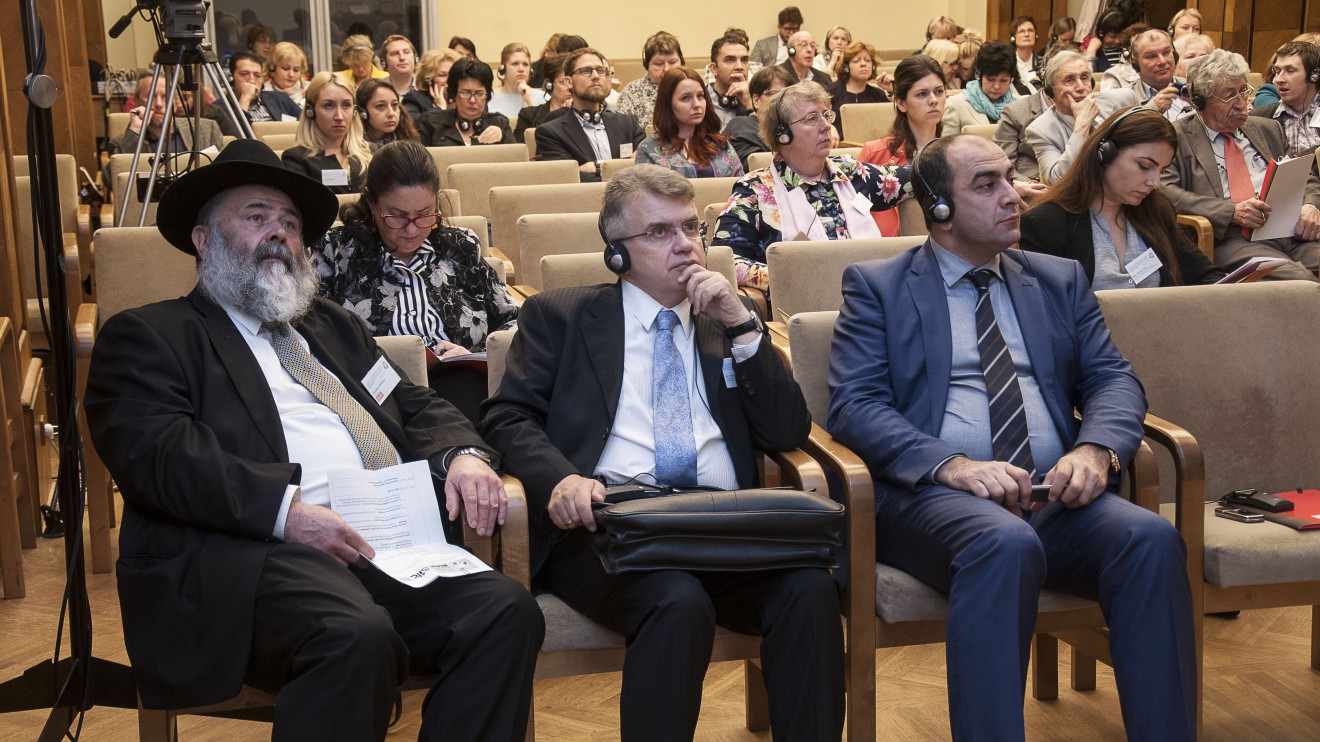
On May 16-17, 2016, at the Latvian Academy of Sciences, within the framework of the 4th International Conference "Museums and Memorial Sites of the Holocaust in Post-Communist Countries: Challenges and Opportunities," a Round Table "Forum for European Tolerance. Historical Aspect and Modernity" was held. It was attended by more than 70 experts and researchers from 10 countries around the world, representing renowned universities and independent research centers specializing in the study of tolerance issues. The round table was organized by the Latvian non-governmental organizations Shamir Society and the European Centre for Democracy Development.
The event was opened by Prof. Zehavit Gross of Bar-Ilan University, head of the UNESCO department. Presentations were given by Prof. R. Boshki of the University of Tübingen, Dr. Aaron Schneier from the Israeli Yad Vashem Institute, member of the Radicalism Research Group of the History Department of Northampton Institute (UK) Dr. A. Kastriota, Associate Professor of Sociology at Eötvös Loránd University (ELTE) (Hungary) I. Barna, and many others. The pan-European report "Xenophobia, Discrimination and Aggressive Nationalism in Europe," prepared by the European Centre for Democracy Development, was presented by its president Valery Engel.
The Round Table is a separate event, organized for the first time in Europe. Its conduct within the framework of a conference dedicated to the Catastrophe of European Jewry is extremely important both from a scientific and practical point of view, as it clearly demonstrates – we study the past so as not to repeat its mistakes in the future. After all, the Holocaust did not begin with gas chambers, it did not even begin with A. Hitler's rise to power. It began with demonstrations of thugs with swastikas on their sleeves, with attacks on Jews, it began with a seemingly harmless book called "Mein Kampf."
The speakers emphasized that this connection between history and modernity is important, since the new generation, calmly watching the growth of xenophobia and the popularity of right-wing radical parties, should know how such social processes can end.
At the conclusion of the round table, it was announced that the Baltic Center of Tolerance would be transformed into the European Center of Tolerance, which will become not only an expert center but also a discussion platform, the goal of which is to prevent conflicts.